




Walk In and Discover a Museum Like No Other on Earth
- 1243 read by
- 28.12.2025 20:35
Museum of Miniature Books in Baku: The Only Dedicated Museum
Needless to say, there’s no end to museums devoted to countless things related to human civilization.
Or, on a broader scale, to every living or non-living thing, like:
History museums (ex. British Museum), art museums (ex. The Louvre), museums for prehistoric species (ex. Royal Tyrrell Museum), etc.
You won’t believe it, but there're specific museums for failed products (ex. Museum of Failure in Sweden).
And even museums for relationships (ex. Museum of Broken Relationships in Croatia) as well.
But among those, there's one in Baku, Azerbaijan, that looks unlike any other in the world:
I mean the first and only dedicated museum for miniature books - The Museum of Miniature Books (Miniatür Kitab Muzeyi in Azeri).
So, if you're also a book lover, or love to experience something special or memorable, or just want to find an awesome thing to do in Baku, this article will help you learn everything you need to know about the Miniature Book Museum, like its:
Brief opening story;
Miniature book collection (including rarities);
Opening hours, entry fees, and so forth.
Let’s dive into it.
What Are Miniature Books?
Prior to venturing into all the nooks of The Museum of Miniature Books in Azerbaijan's capital, it'd be wise to understand what miniature books are.
Briefly, of course. Without drawing the longbow or telling a long, boring tale.
Miniature books are incredibly tiny books, usually made to be distinct, artistic, collectible, or practical.
Some folks might think of "tiny" as relative, but these books are very small in the true sense of the word.
As to the modern definition, a book with a height, width, or thickness of less than 3 inches (76 mm) is a miniature book.
But only a century and a half ago, books under 4 inches (10 cm) were considered miniatures.
Predicting the next 100 years is a whole other ball game.
When it comes to miniature books, size-wise, there’re by and large 3 categories of them.
Take a look at the illustration below:
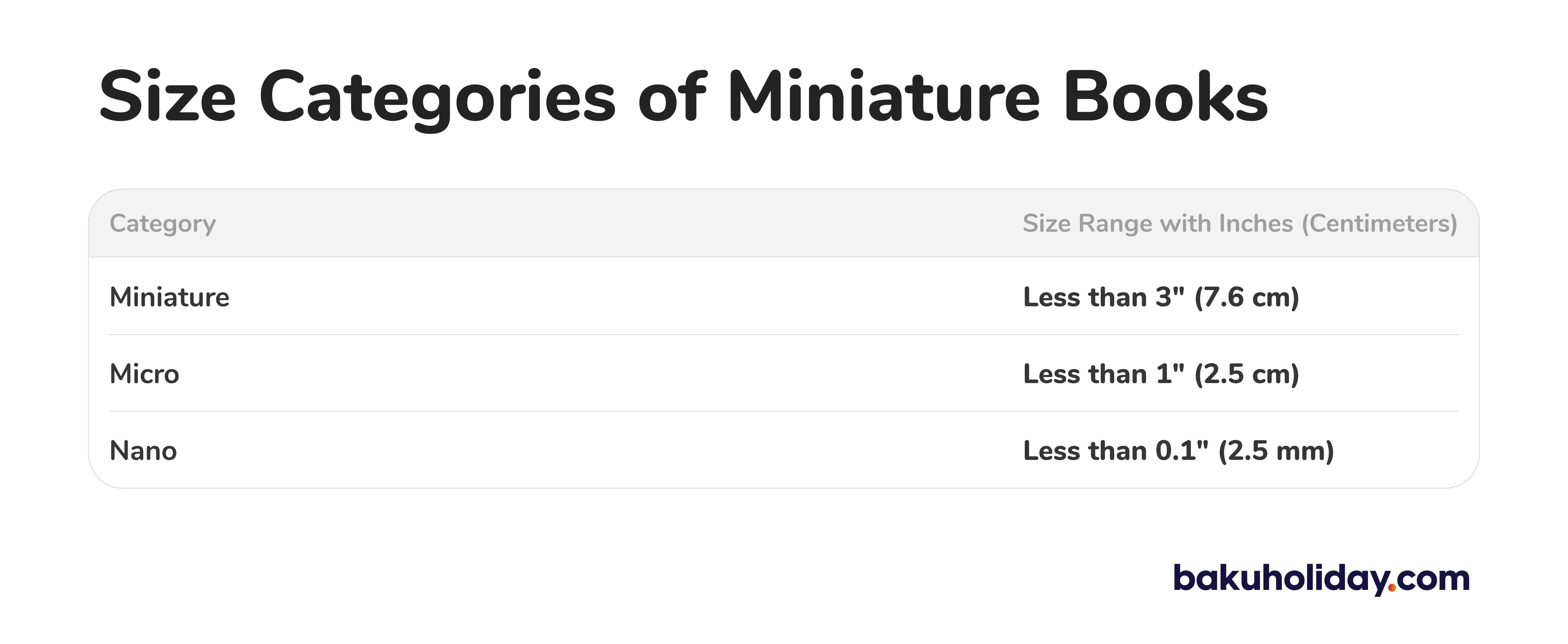
To be most clear, in the first category, that is to say “miniature”, are the books that are most commonly collectibles.
Books included in this category are also counted as readable miniature books without any tools, among others.
On the flip side, micro-size miniature books are published most often for novelty, and they’re rare.
You’ll need a magnifier to read books from that category, like a hand or stand magnifier.
Nano-size, however, is a science demonstration.
You cannot even read it with a magnifier; you’ll need a microscope.
Besides those, there’re also miniature Bible books that can be part of this category.
But we can ignore them because they’re size-wise 1.5" to 2".
Well then, they’re in the first category and not as popular as they were in the 17th–19th centuries.
One last word: all these categories are simply referred to as miniature books, regardless of whether they’re nano or micro.
Opening Story of the Baku Museum of Miniature Books
By all means, opening a unique museum that visitors love is no walk in the park.
But with bookstores and libraries already dotting every corner of the globe, it seemed like a pipe dream.
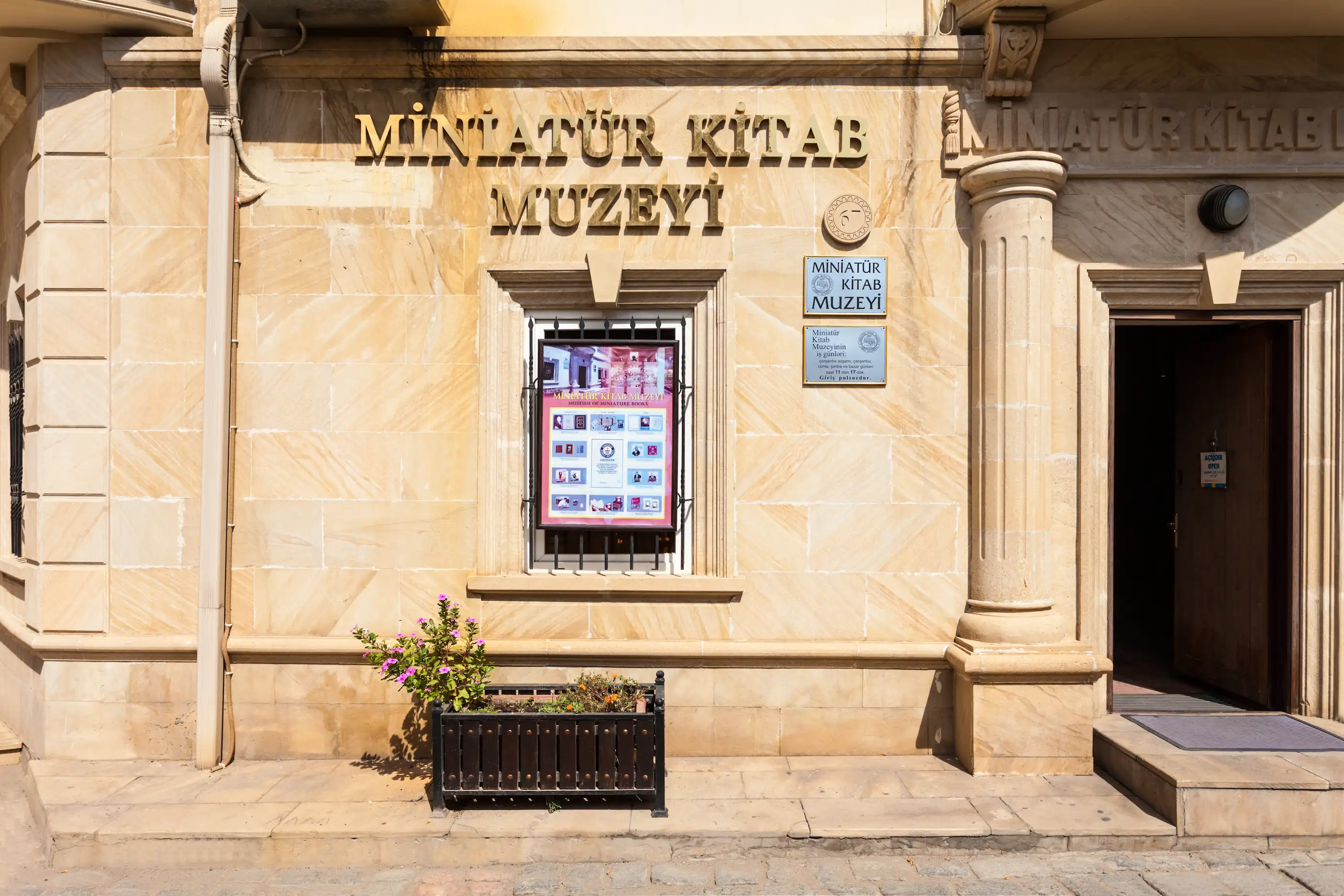
Howbeit, the very first private miniature book museum on Earth opened its doors on April 23, 2002.
April 23 is not any day by coincidence.
Because, more or less 410 years ago, on that very day in 1616, was the day of death of the genius English playwright and poet, William Shakespeare.
Btw, Shakespeare was born on the same day he died.
It's like a twist of fate, but in the same year and on the same day as Shakespeare's doomsday, on April 23 (Gregorian calendar), the death of another great writer, Miguel de Cervantes, took place.
A loss of two geniuses, just on the same ominous day.
That had to be a divine coincidence, though.
Or perhaps, a divine tragedy.
To make a long story short, the fact that World Book Day is also on this day makes it a very smart choice for the launch.
And so, the only museum in the world dedicated to miniature books opened its doors to the public in the spring of 2002.
In the heart of Baku, in the Old Town.
Its founder is Zarifa Salahova, who's been a bibliophile and tireless collector of miniature books for almost half a century.
She’s also the sister of one of the greatest painters and draughtsmen of Azerbaijan, Tahir Salahov.
Miniature Book Collection of the Museum
The Museum of Miniature Books doesn't have thousands of square meters of area (like the National Museum of History of Azerbaijan), though.
To be clear enough, the total area of the museum building is about 165 sq m (roughly 1,800 square feet).
And only 145 sq m of the museum is at the disposal of visitors to showcase its collections.
Nonetheless, it doesn't mean that its book collection is not large, varied and rich.
Exactly 5,800 books are in the museum's collection, ranging from DIY miniature books to rare oldies, the museum's website says.
And again, exactly 3,500 of them are in the "miniature" category, which is Category 1.
So that means they meet the standards of the Guinness Book of Records as well.
All of the book museum's collection is on display in a whopping 39 carefully arranged glass vitrines throughout the museum.
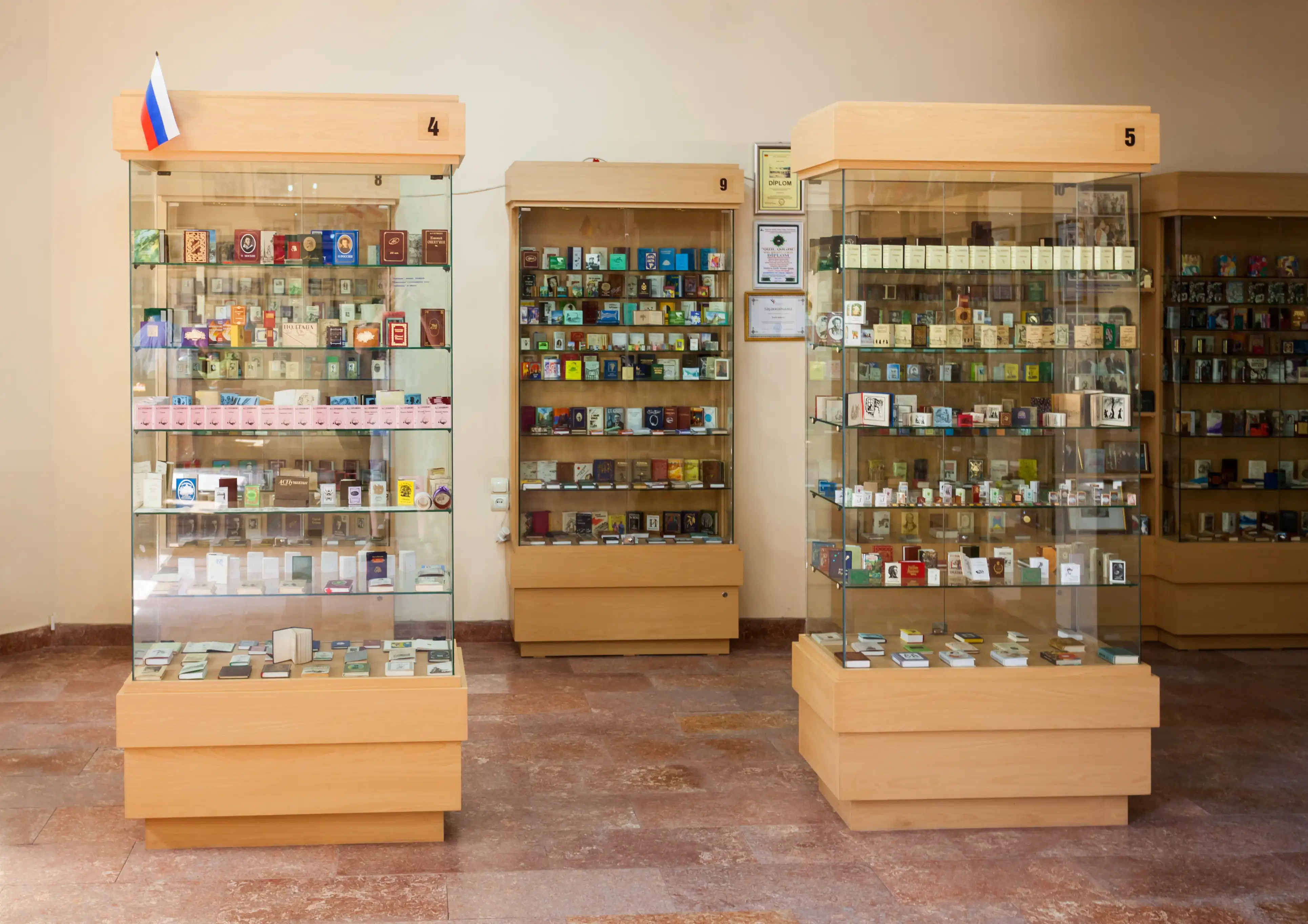
Honestly, I don't want to tell you all what you can see and explore, glass vitrine by glass vitrine (because it may be boring for you).
If you want detailed information beforehand, just visit its official website.
But to be helpful for you to get a grasp of what you’ll see, I can easily divide these glass vitrines into 3 parts.
Let’s look at them.
#1. Vitrines Opposite the Entrance (Vitrines 1, 2 and 3)
As soon as you set foot in the miniature book museum, you'll see 3 beautiful glass vitrines in front of you.
The highlights of the museum are right there.
In the glass vitrine in the center (counted as the 1st vitrine), you'll see mini books published in Azerbaijan.
As suggested by its name, 99.9% of this shelf consists of mini books, not miniature ones.
And it’s dedicated only to Azerbaijan.
The second vitrine on the right-hand side of this one, on the other hand, is a fair dinkum gem.
In this glass case, you'll see the most insane rarities of the museum's collection:
From miniature Shakespeare books to books of other writers that meet the micro category.
4 among them are the best part. They’re in the nano category.
Flowers of the Four Seasons - 0.75 mm (22 pages, by Toppan, Japanese printing company)
Alphabet of Flowers
Symbolism of Precious Stones
Signs of Zodiac (each of those 3 is 16 pages and in 2 mm × 2 mm format)
You'd be hard-pressed to see these books with the naked eye, let alone their contents.
Because there is no difference from just a dot, especially the first one.
Finally, in the third glass case, you can see the best of the museum’s religious miniature book collection, like:
Gospels (messages about who Jesus Christ is), Korans, Torah, etc.
You should see those miniature book covers. They’re gorgeous.
#2. Vitrines 4 to 28 (Miniature Books from the Soviet Era)
Because Azerbaijan also was once part of the Soviet Union for about 70 years, vitrines 4 to 26 mainly feature publishing materials from the Soviet era.
Don’t get me wrong.
It doesn’t mean that section is fully dedicated only to Soviet Azerbaijan’s printing materials or writers.
V.v., this means those glass cases showcase various miniature books from the states that were somehow related to the USSR.
Like Ukraine, Poland, Vietnam, Latvia, Yugoslavia, Germany, etc.
And even Turkey, Spain, Italy, and so on (despite the fact that they were never related to the USSR).
A couple of these vitrines are sort of mixed (I gave up).
As for the books in this section of the Museum of Miniature Books, it's rather interesting.
For example, vitrines number 4-5 are both dedicated to the works of the famous Russian classic, the great Alexander Pushkin.
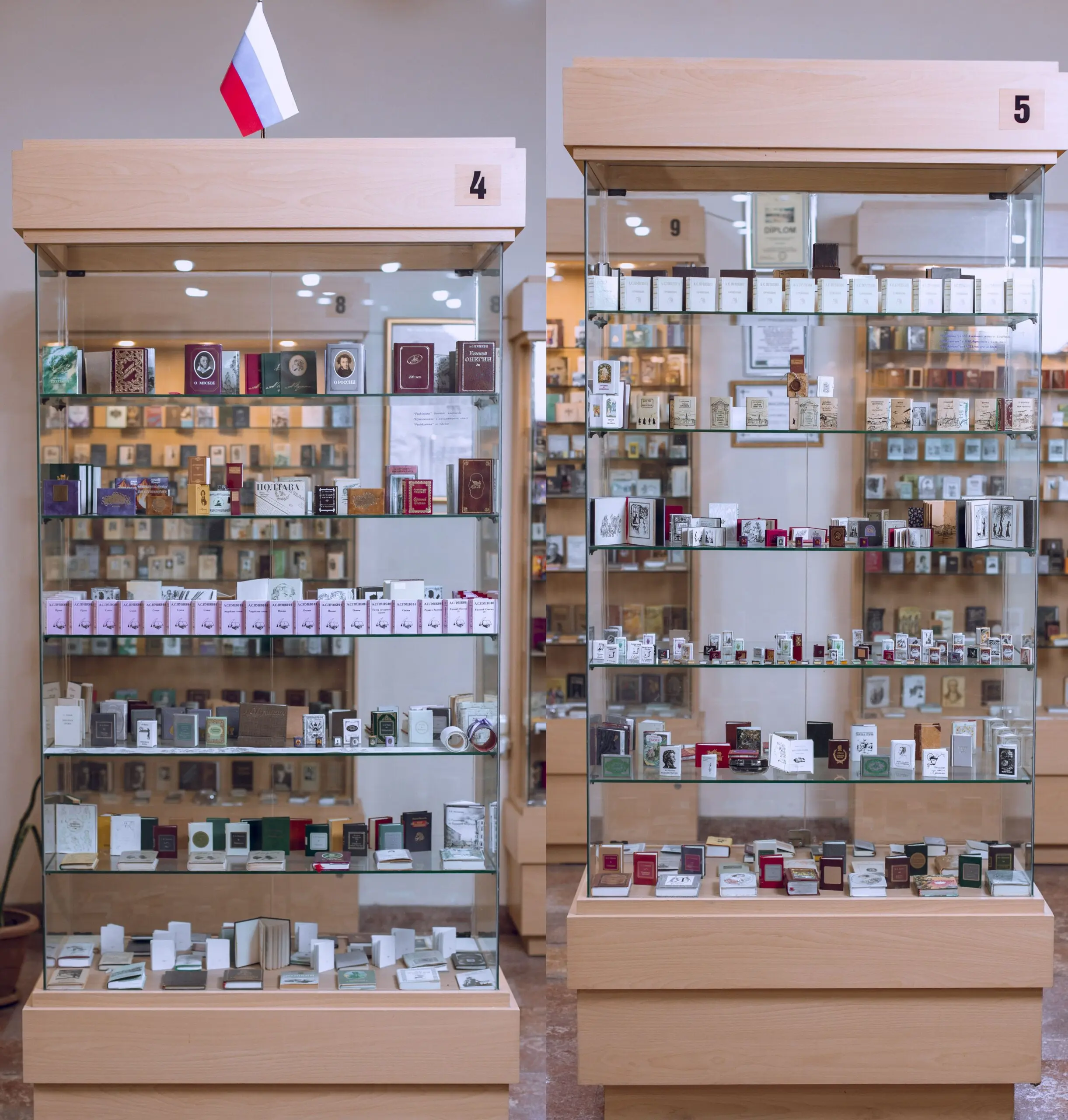
Moreover, vitrines number 22, 27, and 28 are specifically related to children’s literature.
So, you’ll see in this section some perfect examples of miniature children's books as well.
Long story short, this is the greatest part for those who are mostly interested in Russian classics and other classics that can be associated with the Soviet time.
And also for those who love children's literature.
#3. Vitrines 29 to 39 (Books from the Rest of the World)
In these last 10 glass vitrines of the museum, you can see many examples of miniature and mini books from the rest of the world.
Like from Thailand, Norway, the US, and so on.
It’s not over yet.
You can also explore some dedicated cases for sports and the olympic movement, as well as geography.
But among them, my favorite is vitrine number 37,
because that part exhibits a miniature bookshelf with books as well.
In that bookshelf, there is a complete collection of Shakespeare’s works:
A whopping 40 volumes in a format of 33 × 40 mm.
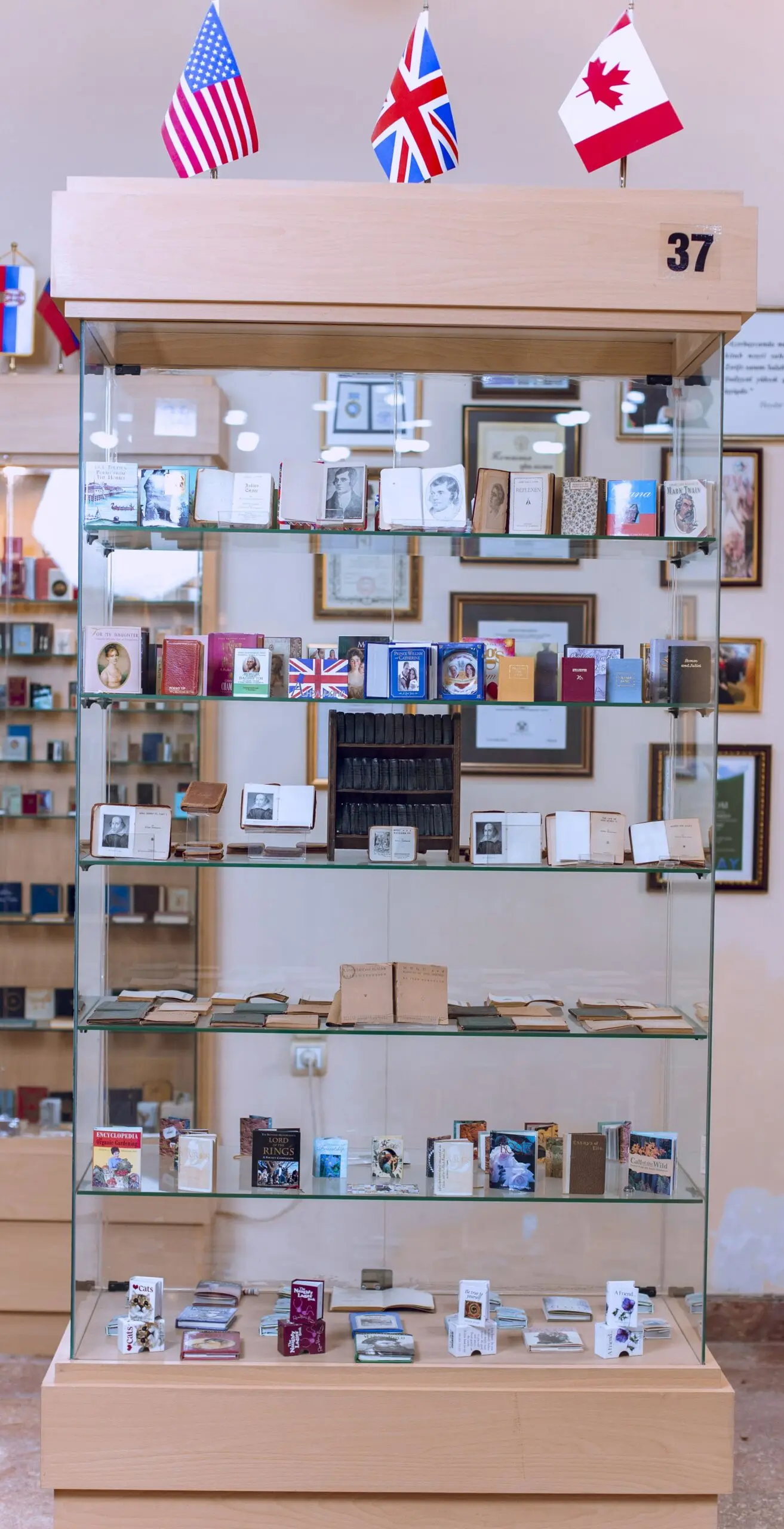
There’re also Shakespeare’s works in a bigger format, but quite mind-blowing leather-bound editions.
That’s all.
Lastly, you can be 100% sure that visiting the Museum of Miniature Books is definitely worth it.
Its location is great (67 Old City of Baku, 1st Castle Lane), and apart from Monday and Thursday, it’s open to visitors from 11 am to 5 pm.
Great thing?
Entrance is completely free.
Have a nice visit.
Need help planning your Baku Tour? For online reservations, reach out to us at this number » +994 992 72 22 27.

Related Posts
The blog section of our website is a curated collection of informative and inspiring articles.








Leave a Comment